
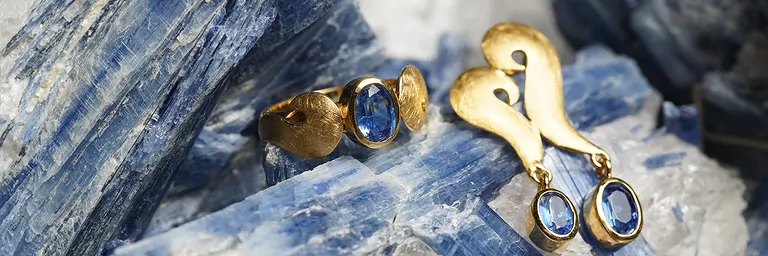
Stone of the Month March 2026: Kyanite – Meaning and Effect
March is the month of transition, of magic between winter and spring. Warmth slowly returns and the days grow longer. It is a time of growth and small steps, of the first signs of spring. March encourages us to leave winter behind and welcome the new into our own lives. The days are getting brighter, the air clearer – it is the breath of spring that invites us to become active again.
In this energetic time of new beginnings, kyanite helps us to choose the right path with prudence and careful consideration and then to follow it with determination. With its support, we can recognize which things in our lives are rooted in ourselves and which factors are beyond our control. This allows us to remain true to ourselves, feel our own identity, and work independently on the further realization of our plans.
Mineralogical profile of kyanite
Formula: AI2[O/SiO4]
Category: island silicate
Occurrence: metamorphic; characteristic mineral for crystalline slate
Color: sky blue, cornflower blue, blue-green, yellow-green, usually mottled; rarely yellow, white, or pink.
Small amounts of iron oxide Fe2O3 are responsible for the typical blue color, which is the most common in nature and therefore the predominant color on the market.
Luster: vitreous, also pearly on cleavage surfaces
Crystal system: triclinic
Mohs hardness: 4 to 4.5 in the vertical direction; 6 to 7
across it Cleavability: perfect cleavability; fibrous or brittle fracture
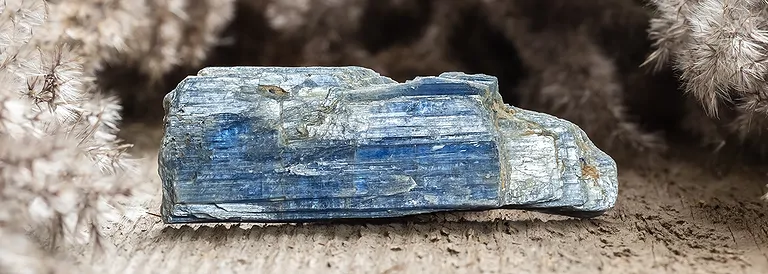
Crystal habit: long, columnar crystals, radiating, fibrous, leafy aggregates
Localities, main supplier countries: Over 1400 localities are known worldwide to date. Rough stones, crystals, and items produced from them, such as Tumbled Stones, mostly come from Brazil (Minas Gerais and Bahia) and India; high-quality, intensely blue stones for jewelry production come from Nepal (Kali Gandaki region), Kenya, and Tanzania. Greenish and orange stones are also known from various locations in Africa.
Kyanite localities in Germany are mainly known from the Upper Palatinate Forest (region around Falls and Marktschorgast), the Münchberg Massif in Upper Franconia, and the district of Dithmarschen (Schleswig-Holstein). However, these localities do not yield well-crystallized or collectible crystals; many kyanites are only microscopically small and integrated into the rocks.
In Switzerland, in Ticino (Pizzo Forno, Alpe Sponda), beautiful crystal specimens are found in classic alpine deposits, which are particularly sought after by collectors.
For mineral shops and other commercial customers: Tumbled Stones, jewelry, and strands of kyanite beads
Availability: Blue kyanite is more commonly found in stores, while kyanite in other colors is a rarity
Use: Kyanite serves as a basis for the manufacture of porcelain and highly refractory products.
In astrology, kyanite combines the spontaneity of those born under the sign of Aries with a clear mental focus.
Chakra assignment: Brow chakra
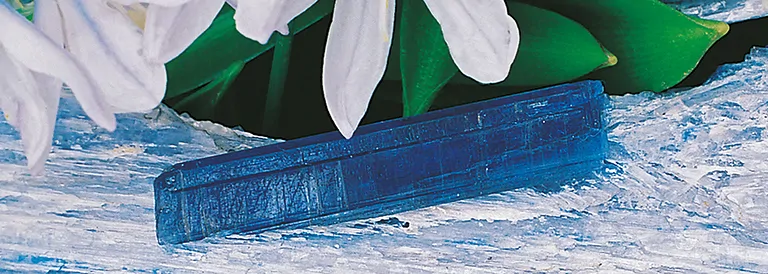
Origin of the name kyanite and synonyms
The name kyanite comes from the Greek "dis" ("two") and "sthenos" ("strength"), meaning "double strength, double hardness." The mineral was named in 1801 by French mineralogist René-Just Haüy, who referred to its electrical properties and varying scratch hardness in different directions.
Kyanite is another name for the mineral disthene, given by Abraham Gottlob Werner in 1789. This term originates from the Greek "kyanos" ("blue") and describes the predominant color of the mineral. The name kyanite is also spelled zyanite, zianite, kianite, or cyanite in literature. The mineralogically correct name according to the IMA (International Mineralogical Association) is kyanite. However, the name kyanite is traditionally used in German-speaking countries.
"Kyanos" was formerly the collective name for all blue minerals, including Azurite and lapis lazuli. The mineral kyanite was not defined as a separate mineral until the 18th century. There are therefore no records of its use and effects from earlier times.
Unusual, rather older synonyms for the mineral are sappar, talc schorl, sapparite, sapphire spar, munkrudite, disthene spar, pseudo-Andalusite, and, especially in the Alpine region, rhaetizite. Occasionally, misleading fantasy names such as "blue sapphire slate" can be found in the trade.
Tumbled Stones made of Kyanite at wholesale prices
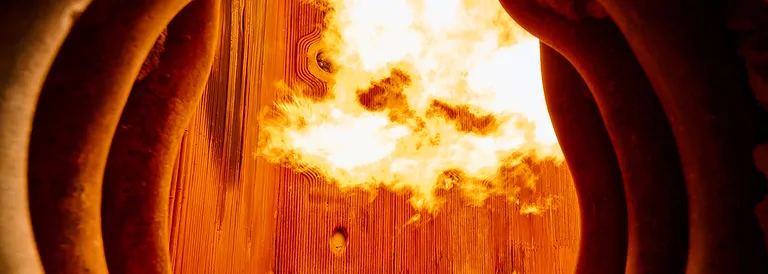
Industrial use of kyanite: Mullite
Kyanite has been of great technical importance since the 19th century. Due to its special property of transforming into heat-resistant mullite when fired, kyanite was used early on in the manufacture of refractory materials. The gemstone was and is used in furnace linings, fireclay bricks, foundry molds, and in the ceramic industry.
These processes are still in use today: kyanite continues to be used as an important raw material for refractory products. When heated, kyanite expands and forms mullite – an extremely temperature- and shape-stable material that is used in blast furnaces, steelworks, glass furnaces, and technical ceramics.
Mullite can also occur under natural conditions, but this is extremely rare. The name mullite comes from the Scottish island of Mull. The mineral mullite was first scientifically described there in 1924 by geologists N. L. Bowen, J. W. Greig, and E. G. Zies.
Rough stones, bracelets, and necklace strands made of Kyanite for resellers
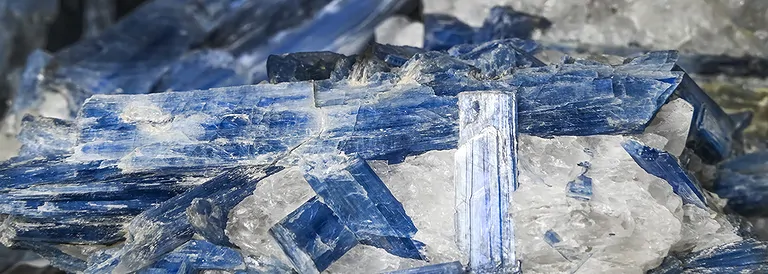
Kyanite – a gemstone with special requirements
Kyanite fascinates with its expressive color and extraordinary mineralogical properties. Its intense, often sapphire-like blue tones in particular make it a real eye-catcher in the jewelry sector. Depending on its structure, it also has a silky sheen that gives the stone a lively, almost shimmering surface. Typical are the long prismatic crystals, which are ideal for natural or only slightly processed jewelry.
As attractive as kyanite is visually, it is just as challenging to work with. The stone has perfect Cleavability in one direction, making it susceptible to breakage. In addition, it has a special feature: its hardness is directional. It varies significantly depending on the crystal orientation – a fact that must be taken into account when cutting.
Jewelry with kyanite for jewelers and jewelry stores
In addition to paying attention to the crystal direction, only gentle pressure and sufficient cooling can be used during cutting to avoid damage to the stones. Kyanite is not an uncomplicated gemstone, but that is precisely what makes it so appealing. If you take its mineralogical characteristics into account, you will obtain an expressive gemstone with an extraordinary color effect and individual charisma.
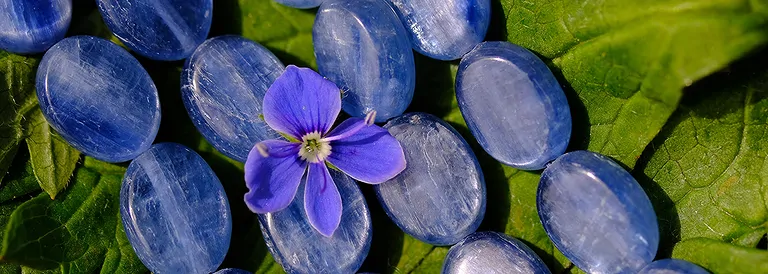
Use of kyanite in crystal healing and gemstone wellness
Kyanite is one of the special gemstones in crystal healing. Its clear, structuring energy stands for serenity, awareness, and determined strength. Worn as a gemstone or used consciously, kyanite helps to gain inner clarity and develop new capacity for action. Kyanite conveys the power to take responsibility for one's own life. It dissolves victim attitudes and rigid ideas about fate. It directs our attention to our own thoughts and actions. This leads to the occurrence of a new awareness of our own possibilities.
The effect of kyanite combines two crucial qualities: logical, rational thinking and determined, clear action. This combination strengthens inner stability – especially in challenging phases of life. Kyanite promotes identity, supports personal development, and helps you remain capable of acting even in extreme situations.
Large selection of kyanite for commercial customers
Worn as a gemstone necklace or bracelet, kyanite accompanies you through phases of reorientation and inner clarification. It calms agitated emotions, organizes your inner imagery, and promotes a peaceful mind. Burdensome thoughts and frustration lose their weight, and clarity comes to the fore.
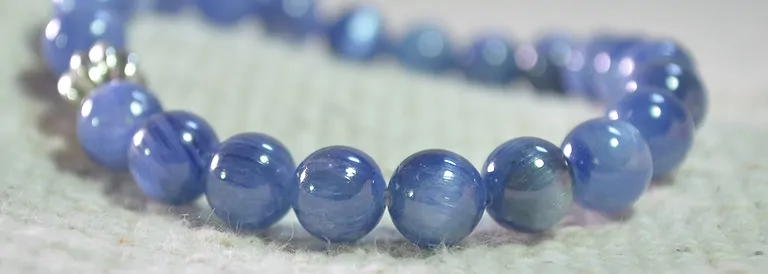
Conscious, mindful use also enhances its quality: holding kyanite in your hand, calmly observing it, placing it on your neck or wearing it on your body for a long time – this is how the gemstone unfolds its structuring and strengthening presence particularly intensively. Its special aura combines calmness with determination – a combination that is particularly valuable in turbulent times.
Massage sticks made of disthene with ruby are used in gemstone wellness when support is needed to complete one's life task and to maintain the ability to act in extreme situations. Sticks combined with fuchsite and ruby strengthen integrity and individuality and help to maintain independence in stressful situations.

Use of kyanite in the production of gemstone water
Kyanite is valued in the field of gemstone water due to its special properties. As an aluminum silicate (Al₂SiO₅), it is chemically stable and fundamentally water-resistant. However, its pronounced cleavability and often lamellar or fibrous structure require careful handling.
Many kyanites available on the market are not made of solid, compact crystals, but of flaky aggregates. This can lead to fine particle detachment in individual cases during prolonged direct contact with water. For this reason, the indirect method is recommended for the production of gemstone water in practice – this protects both the stone and the drinking water.

Suitable methods include the glass-in-glass method, the use of a separate test tube, or placing the stone directly next to the water container. These applications protect the natural structure of the mineral and ensure hygienic, safe production of gemstone water.
In the case of particularly compact, crack-free kyanite, direct application is possible in principle, but should only be carried out after careful examination of the material. Michael Gienger lists kyanite in his bestseller "Water Stones" as a powerful gemstone water.
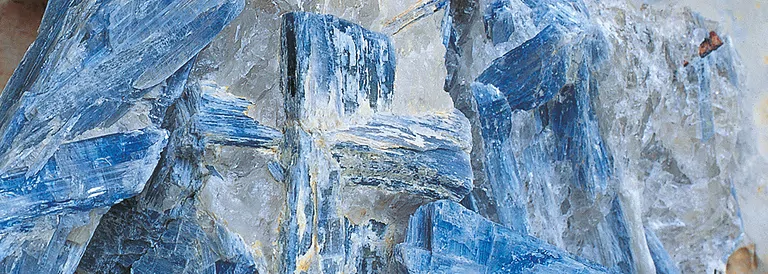
Occurrence of kyanite
Kyanite, mineralogically known as disthene, occurs under extreme conditions deep within the earth. It occurs during the metamorphosis of crystalline schist at depths of more than 15 kilometers and at temperatures of over 1,500 °C.
These extraordinary conditions of formation make kyanite a typical indicator mineral for a specific pressure-temperature ratio. Its localities provide geologists with important clues about the history of formation and the conditions of transformation of the respective rock.
Kyanite occurs primarily in highly pressurized metamorphic rocks. Common accompanying minerals are: mica, garnet, quartz, and rutile.
Tumbled Stones, jewelry, and more made of Kyanite for dealers
Well-formed crystals, which often show twinning or intergrowths, are particularly interesting for collectors. These natural crystal formations give kyanite clusters an extraordinary aesthetic and make them sought-after collector's items.
The extreme conditions under which it forms are also reflected in the mineral's special properties—such as its directional hardness, which makes kyanite so unique in mineralogical terms.
Varieties and colors of kyanite
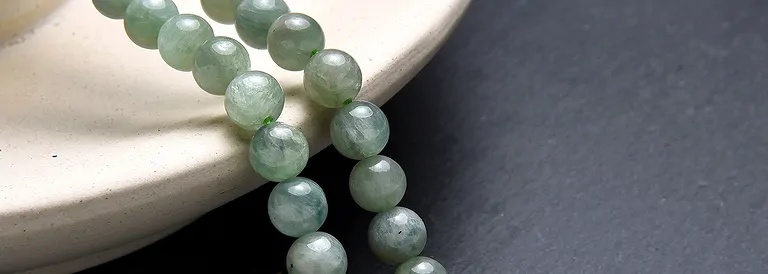
Kyanite has no independent mineralogical varieties with their own names – but it does have distinct color variations caused by trace elements and structural features. In addition to the typical blue, there are also greenish-blue to green kyanite as well as gray-silvery and whitish to colorless varieties. Stones with a yellowish or orange color are very rare.
The coloration of kyanite occurs mainly through the incorporation of trace elements into the crystal lattice during crystal formation:
-
Iron (Fe²⁺/Fe³⁺) → responsible for the typical blue hues
-
Chromium (Cr) or vanadium (V) → can produce greenish nuances
-
Titanium (Ti) → can contribute to the intensification of bluish hues
-
Minor foreign admixtures or structural defects → lead to gray or milky appearances
Colorless or very light-colored kyanite contains hardly any coloring trace elements.
A zonal or streaky color distribution is often characteristic. Due to its triclinic Crystal system and anisotropic structure, kyanite can exhibit growth zones of varying intensity, have varying color depths along the crystal axes, and display slightly different color effects depending on the viewing angle. This property contributes significantly to its lively, sometimes silky shimmering Crystal habit.

Possible confusion with Kyanite
Due to its mostly blue color and elongated crystal habit, kyanite can be confused with various other minerals. Intensely blue, transparent kyanites may superficially resemble Sapphire, but Sapphire is significantly harder (hardness 9) and does not have pronounced Cleavability. Dumortierite in quartz can also superficially resemble kyanite. However, kyanite forms independent, leaf-like crystals, while dumortierite is usually present as an inclusion in quartz. Other possible confusions, especially with cut stones, are blue tourmaline (indigolite), iolite (cordierite), and blue Spinel.
Kyanite Tumbled Stones, jewelry, and more at wholesale prices