Stone of the Month for October 2026: Shattuckite
Nature displays its full splendor of colors in October. It is a time of letting go, when the trees shed their leaves and prepare for the coming winter. For us, too, it is a month of reflection and reevaluation. October invites us to look back on the past months, pause, and reflect on what we have reaped, both in our outer and inner lives.
Shattuckite is a valued companion during these times of change. As a balancing stone, it is used to promote calm and Serenity, helping us keep a cool head even in challenging situations.
This blue-green gemstone helps us leave burdens and worries behind and look forward with renewed strength. In this way, it can inspire us to tackle new endeavors with confidence and embrace change with an open mind. Shattuckite fosters tolerance, generosity, and understanding in our relationships.
Go directly to the topic:
Profile | Name & Synonyms | Jewelry & Uses | Effects & Applications | Formation | Colors & Localities | Related Minerals
Mineralogical Profile: Shattuckite
Formula: Cu5(SiO3)4(OH)2
Category: Silicates and Germanates
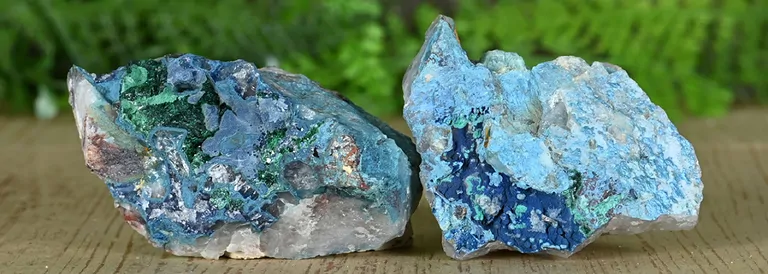
Formation: secondary in the oxidation zone of copper deposits, usually associated with other copper minerals and quartz
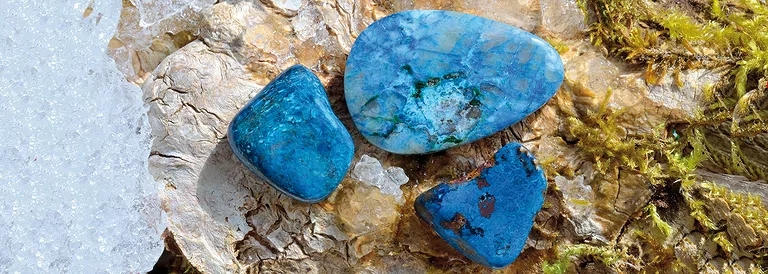
Color: various shades of blue, sometimes turquoise and green
Luster: silky
Cristal system: orthorhombic
Mohs hardness: 3.5–4
Cleavability: perfect
Crystal habit: Shattuckite primarily forms fine, needle-like to fibrous crystals, which are usually intergrown into radiating, clustered, or massive mineral aggregates. Occasionally, Shattuckite also occurs as a pseudomorph of Malachite.
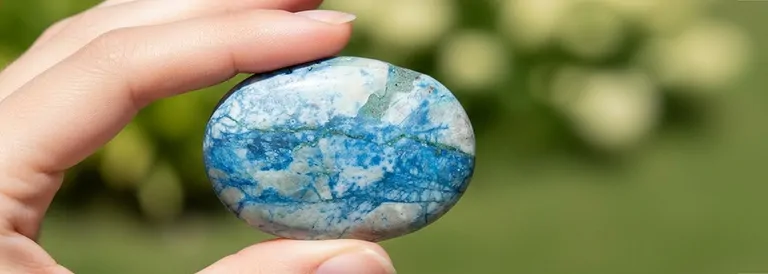
The surrounding host rock is often incorporated into the production of donuts, jewelry, and other cut or polished items. Its light gray to gray-brown color creates a striking contrast to the intense blue-green Shattuckite and gives each piece a unique pattern.
Localities, Major Source Countries: Shattuckite was first discovered in the United States at the “Shattuck Mine” near Bisbee, Arizona—the mineral was named after this locality.
Tumbled Stones, stringed beads, and more made from Shattuckite at wholesale prices
Localities for the mineral can be found all over the world, for example on Heligoland, in Greece, Italy, Mexico, Namibia, Norway, and England—the particularly vividly colored Shattuckites come from Argentina. The strands and polished items available on the market are mostly cut from raw material sourced from Namibia.
Availability: good to rare, depending on quality
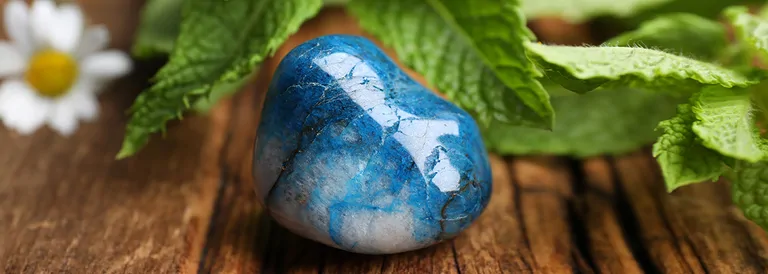
Origin of the Name Shattuckite and Synonyms
The name “Shattuckite” derives from its type locality: the mineral was first discovered at the Shattuck Mine near Bisbee in the U.S. state of Arizona. The American mineralogist Waldemar Theodore Schaller (1882–1967) was the first to scientifically describe the mineral and named it after this locality.
The Shattuck Mine itself is named after its founder, Lemuel C. Shattuck, an entrepreneur who played a key role in the development of the copper deposits around Bisbee in the late 19th century. To this day, the mineral’s name serves as a reminder of one of Arizona’s most significant historic copper mines.
One side polished pieces, donuts, drilled focal components, and much more at wholesale prices
The original samples of the mineral—known as the type specimens—are housed at the Smithsonian Institution’s National Museum of Natural History in Washington, D.C. They serve as a reference for mineralogists worldwide to unambiguously identify Shattuckite.
There are no known synonyms or trade names for Shattuckite; however, the misspellings “schattuckite,” “schattukite,” or “shattukite” are occasionally encountered.
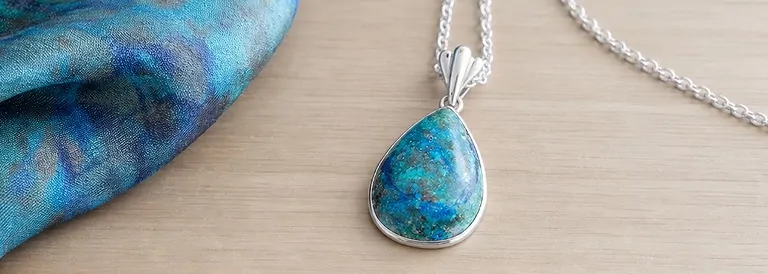
Use of Shattuckite as a Gemstone and Display Piece
As a relatively newly discovered mineral, Shattuckite has only gained attention in recent years. Thanks to its extraordinary, intense blue color and its often fascinating intergrowths with Malachite, Chrysocolla, or quartz, Shattuckite is among the most sought-after copper minerals for collectors, jewelry designers, and mineral enthusiasts. Due to its rarity, the mineral has little industrial significance but is widely used as a gemstone and decorative stone.
Shattuckite as a Gemstone
Solid, compact Shattuckite lends itself exceptionally well to cutting and polishing. It is primarily crafted into cabochons, pendants, beads, donuts, palm stones, and decorative objects. Stones are particularly prized when, in addition to their rich blue color, they display natural patterns of Malachite, Chrysocolla, or quartz, or create a striking contrast with the gray host rock.
For jewelers and jewelry stores: Shattuckite jewelry
Since shattuckite is relatively soft, with a Mohs hardness of about 3.5 to 4, it is particularly suitable for pendants, earrings, and jewelry pieces that are not exposed to heavy mechanical stress. For rings, however, it is recommended only to a limited extent.
Collector’s and Display Pieces
Exquisitely formed crystal specimens and grape-like aggregates are among the most sought-after display pieces in mineral and museum collections. Specimens from Namibia, in particular, with their intense blue color and velvety, fibrous structures, are considered some of the most beautiful finds in the world.

Use of Shattuckite in Crystal Healing and Gemstone Wellness
Shattuckite conveys a sense of freshness and promotes flexibility; the mineral also makes it easier to open up to new relationships. It enhances the ability to express oneself, helping to prevent or clear up misunderstandings.
This blue-green gemstone enables one to be more tolerant and generous in interactions with others and to grant more freedom. With the stone’s support, emotional baggage and worries can be released, allowing new endeavors to be tackled with renewed strength.

Formation of Shattuckite
Shattuckite forms as a secondary copper mineral in the oxidation zones of copper-rich deposits. There, originally present copper ores are chemically transformed by oxygen-rich water and other weathering processes. Under the influence of copper-bearing solutions and silica-rich water, Shattuckite eventually crystallizes.
One side polished pieces, donuts, drilled focal components, and much more at wholesale prices
Shattuckite typically occurs alongside other copper-bearing minerals such as malachite, Azurite, Chrysocolla, Dioptase, and cuprite. It is also frequently intergrown with quartz, which, although not a copper mineral, often occurs as an accessory mineral. Shattuckite particularly often forms fine-needle-like to fibrous crystals that have grown together into radially radiating, clustered, or massive mineral aggregates.
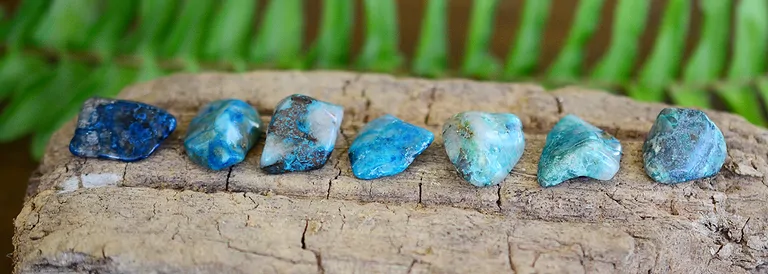
Since its formation requires very specific geological conditions, Shattuckite is found at only a few localities worldwide. Among the best known are the historic copper mines near Bisbee (Arizona, USA) and the famous deposits in Namibia, from which most high-quality jewelry and collector’s items originate today.
Shattuckite owes its intense blue color to its high copper content, which is also responsible for its close relationship to other blue and green copper minerals.
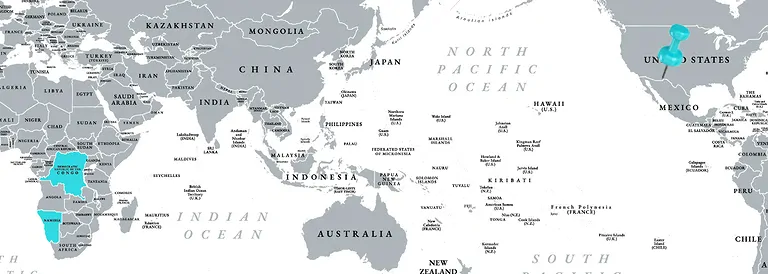
Varieties and Color Differences in Shattuckite
There are no mineralogically recognized varieties of Shattuckite. Nevertheless, Shattuckites from different localities sometimes differ significantly in color, structure, and crystal habit.
The typical color of Shattuckite ranges from light blue to intense azure blue to dark blue. This is due to varying formation conditions as well as the proportion of associated minerals.
Wholesale assortment featuring Shattuckite as Tumbled Stones, donuts, Silver jewelry, and more
Arizona (USA)
The Shattuck Mine near Bisbee, where the mineral was first discovered, has yielded primarily medium- to dark-blue Shattuckite. Many specimens are fibrous or grape-like in form and closely intergrown with other copper minerals.
Namibia
Shattuckite from Namibia—particularly from the famous copper deposits of Kaokoveld and Tsumeb—is considered to be of particularly high quality. It is often characterized by a vivid royal blue to deep azure blue and frequently occurs alongside quartz, Malachite, Chrysocolla, or Dioptase. These combinations result in particularly attractive pieces of jewelry and collectibles.
The Mesopotamia 504 and Kandesei sites are particularly famous, where localities for Shattuckite exist in unusually well-formed crystals as well as in intensely blue, spherical, and radially radiating aggregates. These specimens are among the most beautiful Shattuckites ever discovered.
Democratic Republic of the Congo
Shattuckite with lighter shades of blue to turquoise often originates from the Congo. It frequently occurs alongside Chrysocolla and Malachite, creating striking color contrasts.
In addition to Namibia and the Democratic Republic of the Congo, Shattuckite is now also reported from individual copper deposits in Mexico, including the Milpillas Mine in the state of Sonora. The specimens found there often consist of attractive intergrowths with quartz and other copper minerals.

Mineralogical Relatives of Shattuckite
Shattuckite belongs to the copper silicates and is formed—like many of its mineralogical relatives—in the oxidation zones of copper-rich deposits. There, it frequently occurs alongside other secondary copper minerals. Although these minerals are sometimes similar in color and composition, they differ significantly in hardness, crystal form, and chemical composition.

Chrysocolla
Chrysocolla is the best-known relative of Shattuckite. Both minerals often display intense shades of blue and turquoise and are frequently found together. However, chrysocolla usually has a more turquoise-to-greenish-blue color, is softer, and predominantly forms massive aggregates. Shattuckite is generally a more vivid blue and more frequently exhibits fine-fibrous or radially radiating structures.

Dioptase
Dioptase is also a copper silicate, but it differs significantly due to its emerald-green color and its exceptionally well-formed, lustrous crystals. While Shattuckite has numerous localities in fibrous aggregates, dioptase usually forms easily recognizable individual crystals.

Malachite
The intensely green Malachite is one of the best-known secondary copper minerals. Chemically, it differs significantly from Shattuckite, but it often occurs alongside it. The combination of blue Shattuckite and green Malachite results in particularly attractive jewelry and collector’s items.

Azurite
Azurite also forms in the oxidation zones of copper-rich deposits. At first glance, its deep blue color is reminiscent of Shattuckite, but azurite usually forms well-developed crystals and contains carbonate instead of silicate. Furthermore, azurite is often darker and has a more intense blue color.

Cuprite
Cuprite consists mainly of copper oxide and is notable for its dark red to nearly black color. It is an important companion mineral to Shattuckite and other copper minerals, but differs significantly from them both in color and chemistry.
Similarities and Differences
All of these minerals owe their striking colors to the copper they contain and are formed under similar conditions in the weathering zone of copper-rich deposits.
While Shattuckite, Chrysocolla, Dioptase, and Plancheite belong to the copper silicates, Malachite and Azurite are copper carbonates, and cuprite is a copper oxide. It is precisely the fact that these minerals occur together that makes many copper deposits among the most colorful localities in the mineral world.