
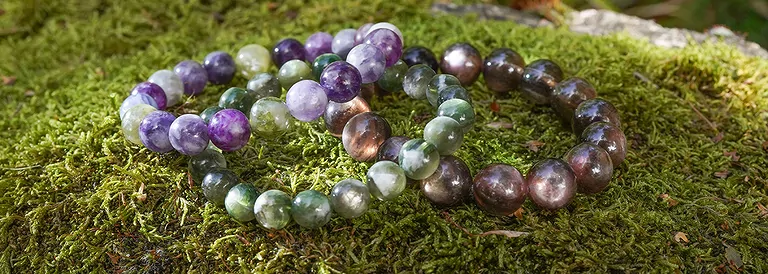
Stone of the Month December 2026: Mica
December is the quiet highlight of the year, a month that shines in the darkness. But it is precisely during this time of silence that the magic of winter becomes tangible. The cold, clear air, the first frost covering the world with a delicate layer – December brings us the peace and pause we long for. It is the month of family, traditions, and the small, meaningful moments that bring us together.
The mica minerals help us to shield ourselves from external influences and strengthen our focus on the essentials. With a clear view, concentration, and the necessary distance, we can review the year and complete any remaining tasks or solve any outstanding problems. This allows us to end the year with inner peace and anticipation for the new year.
Mineralogical profile of mica minerals
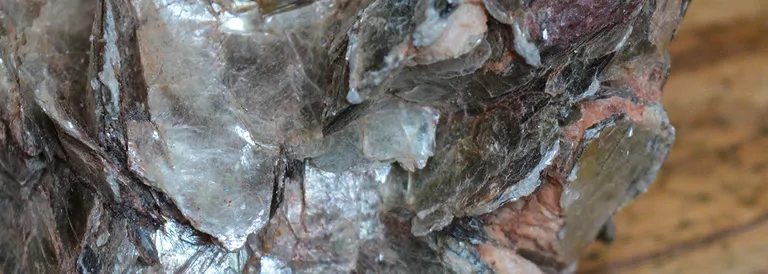
Mica is the name given to a large group of phyllosilicates that are characterized by their perfect basal cleavage parallel to the layers: all minerals in the mica group can be split very easily into thin, elastic flakes. Thin sections reveal a distinctive play of colors known as scintillation.
Mineral class: phyllosilicates
Formation: mostly metamorphic, but also magmatic
Color: white to brown-black, brown (biotite, muscovite), green (fuchsite), pink to violet (lepidolite)
Crystal system: monoclinic; only wonesite is triclinic
Mohs hardness: 2 (parallel to the layers) or 4 (all other directions)
Cleavage: perfect to the layers
Appearance: crystals are rare, often flaky, scaly, more rarely tuberous-shelled aggregates
Occurrence, main supplier countries: worldwide; commercially mainly from Brazil (lepidolite), China, India (Jharkhand, Bihar, and Rajasthan), California (lepidolite), Namibia (lepidolite), Madagascar (lepidolite), Portugal (biotite lenses).
Drilled gemstones, tumbled stones, and more mica items for resellers
Technical applications: Due to its low electrical conductivity, high melting point, and shimmer, mica is important in numerous technical processes and products, e.g., in car paints (pearlescent effect), viewing windows in ovens, safety goggles, as an electrical insulator, and in the manufacture of heating wires (toasters, soldering irons). In the past, mica was used as a vibration membrane in gramophones due to its elasticity.

Origin of the names mica and glimmer, and synonyms
The German name for mica “Glimmer” is derived from the shimmering, shiny surface of the minerals. In many other languages, e.g. English and French, mica is called “mica.” The origin of this name is not entirely clear. It may derive from the Latin “mica” (crumb) or “micare” (to sparkle, to shimmer). The term ‘mica’ has probably been used for the mica group since the early 18th century; originally, these minerals were also called “smicka.”
The term “isinglass” has been in use since the 16th century, derived from “ising” (ice). At that time, very thin layers of light-colored mica were used as panes in windows, lamps, and lanterns.
“Katzenglimmer,” “Katzengold,” and “Katzensilber” are now almost forgotten terms for brown-yellow and gray-black mica. These terms can be found in the writings of Agricola, among others.
For jewelry designers and jewelers: Jewelry and stringed beads made of mica
Mineralogical properties of the mica group
The minerals within the mica group are classified according to their interlayer cations, i.e. the positively charged ions that are present between the individual layers of mica. These include, for example, potassium (K⁺), magnesium (Mg²⁺) and iron (Fe²⁺ and Fe³⁺).
True micas: Micas with more than 50% monovalent cations (mainly potassium, sodium), e.g., aluminoseladonite, annite, biotite, eastonite, fuchsite, muscovite, paragonite, phlogopite, polylithionite, roscoelite, seladonite
Brittle mica: Mica with more than 50% divalent cations (mainly magnesium, iron), e.g., margarite, kinoshitalite, phlogopite, zinnwaldite. Characteristic features are low cleavability and greater hardness.
Interlayer-deficient mica: Mica with few cations, e.g., illite, barammalite, glauconite, lepidolite, rohdinite, wonesite
Iron mica, a finely scaly variety of hematite, does not belong to the mica group despite its name.
Mica commonly found in wholesale
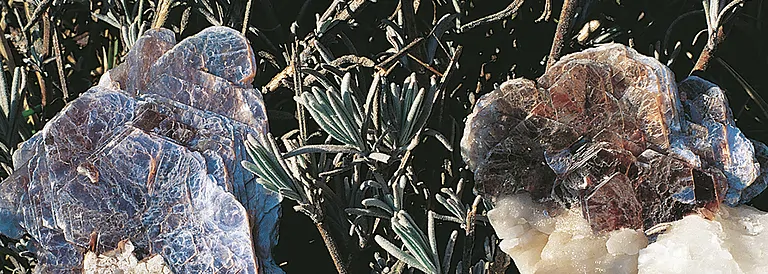
Biotite (iron or magnesium mica): “Biotite” is a collective term for various minerals in the mica group, e.g., annite and phlogopite. Since the mineralogical properties vary, biotite has not been considered a separate, clearly defined mineral since 1999.
Fuchsite (chromium mica): Fuchsite is a special variety of muscovite that is colored green due to a chromium content of 1–5%.
Lepidolite (lithium mica): Mica colored pink to violet by manganese.
Muscovite (white mica): Colorless to white-gray mica, which is colored yellowish, brown, or green due to admixtures of iron. Usually available commercially as brown mica.
Mica items (tumbled stones, bracelets, and more) at wholesale prices
Use of mica in crystal healing and gemstone wellness.
Due to their availability, the three best-known types of mica—fuchsite, lepidolite, and muscovite—are primarily used in crystal healing. All types of mica are used as protective stones.
Fuchsite helps to shield oneself from external influences without becoming inattentive to one's surroundings and fellow human beings. The green mica thus enables one to perceive all things from a (sometimes necessary) distance. New perspectives can be taken, and creative approaches and ideas for solving problems can be developed. In difficult circumstances, fuchsite supports a confident demeanor by increasing mental agility and alertness.
Lepidolite promotes independence and helps you to set yourself apart in large crowds. External influences and distractions can be more easily ignored. Lepidolite strengthens self-discipline, enabling one to take matters into one's own hands quickly instead of hoping and waiting for help from others. Developments and progress are thus steady but calm and without much fuss. All aspects are carefully considered before decisions are made.
Ideas can thus be successfully implemented and goals achieved through one's own efforts. Lepidolite can also be a valuable companion when formulating goals, as it strengthens inner peace and the ability to focus on what is essential. Wearing lepidolite, for example as a bracelet or necklace, has proven to be effective.
Muscovite helps you to remain calm in the face of negative external influences. Muscovite makes it easier to deal with unpleasant circumstances, projects, or fellow human beings, as it helps you to better cope with (inevitable) confrontation. With more inner peace and a relaxed attitude, you can weather the storms of life. Muscovite strengthens your clear view of things and your own incorruptibility.